From Battlefields to Beer Gardens: The Epic History of British Pub Darts
From medieval soldiers to the bright lights of Ally Pally, discover why darts is the ultimate British pub tradition and how it conquered the world.
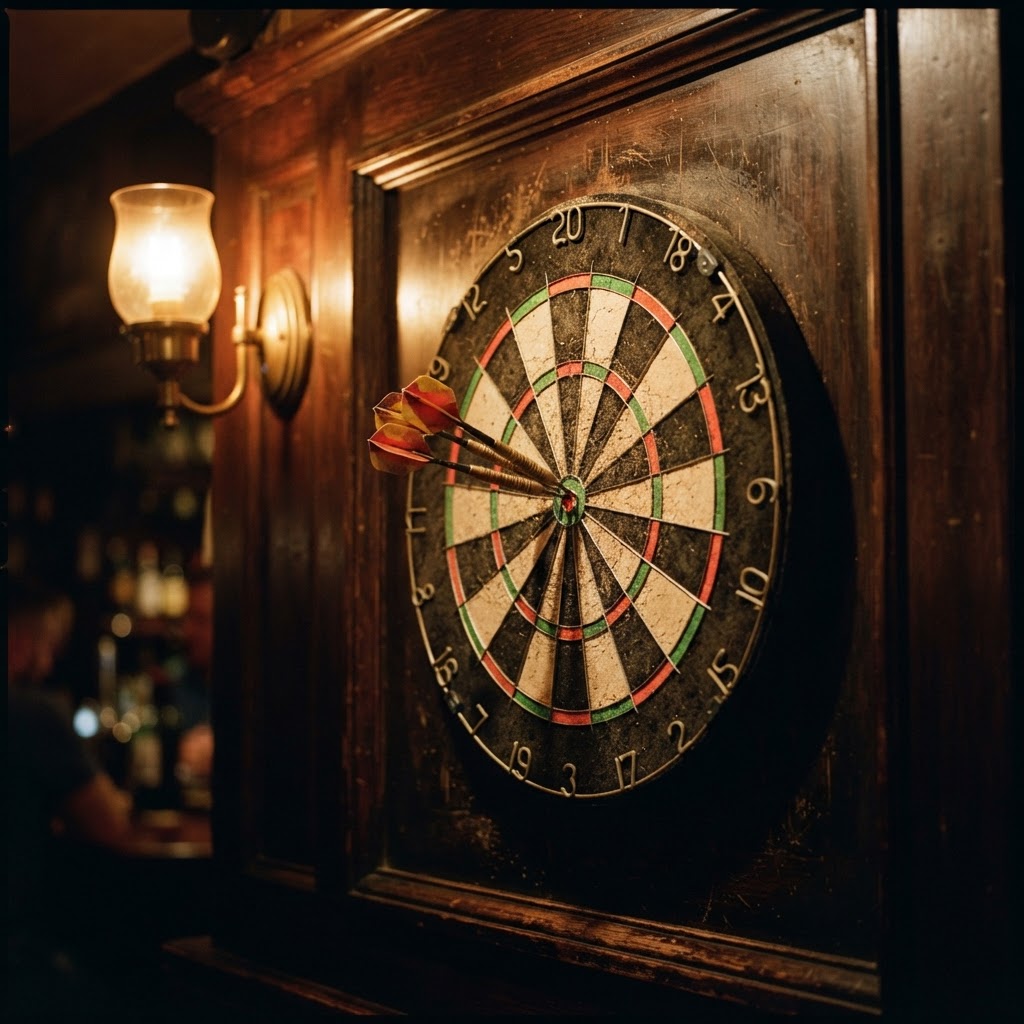
There is a specific sound that defines a proper British pub. It is not just the clink of glasses or the hum of the jukebox; it is that rhythmic, satisfying thwack-thwack-thwack of tungsten hitting sisal. Darts is as much a part of our national DNA as a Sunday roast or complaining about the weather, but have you ever wondered how a game involving throwing miniature spears became the heartbeat of the local? Grab a pint, pull up a stool, and let’s dive into the history of the 'arrows'.
From Battlefields to Beer Barrels
Believe it or not, darts did not start in a smoky backroom in the 1970s. Its roots go back over 700 years to the medieval era. Legend has it that bored soldiers, looking for a way to pass the time between battles, started hurling shortened arrows or spearheads at the upturned ends of wine casks. When the wine barrels ran out, they switched to cross-sections of tree trunks.
Those natural growth rings in the wood? They became the very first scoring zones. As the wood dried and cracked, it created radial lines that eventually evolved into the segments we see today. Even royalty got in on the action; history tells us that Henry VIII was a massive fan, having been gifted a set of 'ornate darts' by Anne Boleyn in 1532. If it is good enough for the King, it is certainly good enough for the local league.
The Birth of the Modern Game
For centuries, darts remained a bit of a free-for-all with various regional rules. It wasn't until 1896 that a carpenter from Bury named Brian Gamlin supposedly came up with the numbering system we use today. The layout was genius—placing high numbers next to low numbers (like the 20 being flanked by the 1 and 5) to punish inaccuracy.
By the early 20th century, the game had firmly embedded itself in pub culture. It was the ultimate 'working man’s sport' because it was cheap to play and didn't require a massive pitch. In 1927, the News of the World established the first major individual championship, and by the time World War II rolled around, the game was so popular that the NAAFI included dartboards in sports packs for troops overseas to keep morale high.
From the Local to the Ally Pally
While the local pub league remains the grassroots soul of the sport, the 1980s and 90s saw darts explode into a televised phenomenon. We moved from the legendary, beer-swilling days of Eric Bristow and Jocky Wilson to the high-octane, rock-concert atmosphere of the PDC World Championships at Alexandra Palace—or 'Ally Pally' to those in the know.
Today, the sport is a global juggernaut. We see 10,000 fans in fancy dress, walk-on songs that rival heavyweight boxing matches, and 'nine-darters' that send the crowd into a frenzy. Yet, despite the bright lights and the millions in prize money, the essence of the game hasn't changed. Whether you are at a professional venue or just having a casual throw at one of our spots in Cramlington, North Shields, or Towcester, the goal is the same: focus, a steady hand, and the hope of hitting that elusive 'one-hundred-and-eighty!'
We love darts because it is inclusive. You don't need to be a marathon runner to compete; you just need a bit of practice and a good group of mates. It is a game that bridges generations, where a youngster can learn the ropes from a seasoned veteran over a packet of crisps. So, next time you see the board glowing under the spotlight, step up to the oche. You’re not just playing a game; you’re continuing a centuries-old British tradition.
By The Cue & Darts Lounge